Episode 12: Biscuitville
Breakfast, Biscuits and Culture: Leading the Biscuitville Workforce
Panelists: Episode 12
Who We Interview in This Lessons from the Field

Belinda Kyle
Chief People Officer
Biscuitville

Listen: Lessons from the Field Episode 12
Audio Recording: Full Episode
Watch: Lessons From the Field Episode 12
Video Recording: Full Episode
Lessons from the Field: Episode 12 Overview
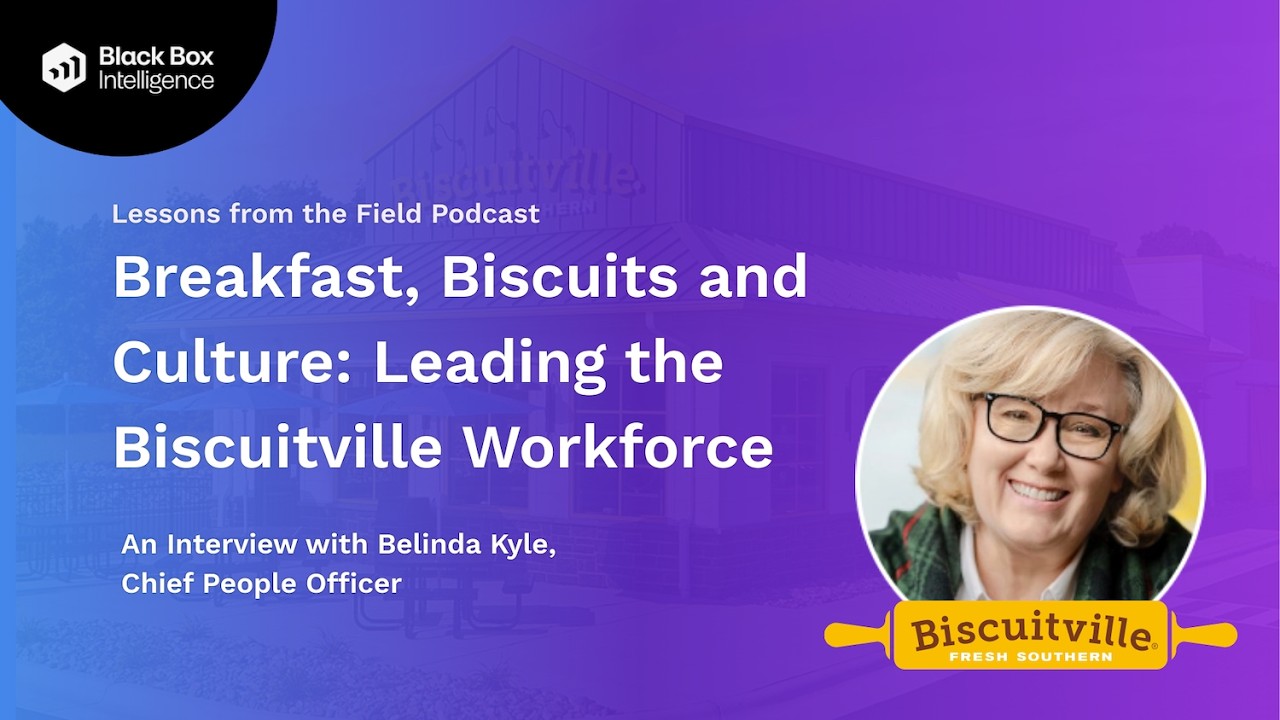
Breakfast, Biscuits, and Culture: Leading Biscuitville’s Workforce [Ft. Belinda Kyle, Chief People Officer]
Episode 12 | 02/04/25
Episode Overview
In the fast-paced world of QSR, Biscuitville stands out—not just for its Fresh Southern® food, but for a unique operating model that fundamentally changes the employee value proposition.
In this episode of Lessons from the Field, Black Box Intelligence CMO Andy Smith sits down with Belinda Kyle, Chief People Officer at Biscuitville. A restaurant industry veteran with deep roots in operations (McDonald’s, Macaroni Grill), Belinda shares how Biscuitville’s commitment to a 2:00 PM close time—“Life After Two”—creates a competitive advantage in recruiting and retention.
Belinda and Andy dig into the realities of modern workforce management, moving beyond theory to discuss practical strategies for reducing turnover, building a leadership pipeline from within, and using industry benchmarking data to validate culture rather than just chase numbers.
What You’ll Learn
-
The “Life After Two” Advantage: How Biscuitville’s unique daypart strategy (closing at 2 PM) creates predictable schedules and drives retention in a turnover-heavy industry.
-
Ops-Led HR: Why starting in operations provides the necessary “boots on the ground” perspective to create HR policies that actually work in the restaurant.
-
Data vs. Instinct: How to use benchmarking data to validate internal performance without blindly chasing industry averages.
-
Simplifying Engagement: Why Biscuitville focuses on one or two actionable behaviors from engagement surveys rather than overwhelming GMs with complex action plans.
-
Succession Planning: The systems and competencies required to successfully promote hourly shift leaders into management roles.
Key Quotes
“You learn very quickly that people strategies must work in a real restaurant and not just in theory… That operator lens has helped to keep me grounded and focus on what’s practical as well as scalable.” — Belinda Kyle, Chief People Officer, Biscuitville
“Pay is really the price to get in. Leadership quality and how the work gets done are what sustain retention.” — Belinda Kyle, Chief People Officer, Biscuitville
About the Guest
Belinda Kyle is the Chief People Officer at Biscuitville. She is an award-winning restaurant industry veteran with a career that began on the front lines of operations. Before joining Biscuitville in 2022, Belinda held leadership roles at major brands including McDonald’s, Macaroni Grill, and Dinosaur Bar-B-Que. Her unique background allows her to blend operational discipline with strategic human resources, focusing on leadership development, retention, and maintaining Biscuitville’s family-owned culture across 85+ locations in North Carolina, South Carolina, and Virginia.
Read the Transcript
Andy Smith: Hey, everyone. I’m Andy Smith. I’m the chief marketing officer at Black Box Intelligence, and, welcome to this edition of our lessons from the field series. This is where we tap into the expertise of industry leaders to explore key challenges and opportunities in the restaurant space. So today, I am thrilled to be joined by a very special guest, Belinda Kyle, who’s the chief people officer at Biscuitville. Belinda is an award winning restaurant industry vet, having started out in ops before moving into HR. We’ll get into Biscuitville in a second, but for anybody who doesn’t know, it’s a much loved QSR brand focused on the breakfast daypart, founded in 1966 and is now at more than 85 locations in North Carolina, South Carolina, and Virginia. So, Belinda, welcome. How are you doing today? I hope I got all that right, so please correct me if I got any that wrong. My research came up short.
Belinda Kyle: You did. Good job. Good job.
Andy Smith: Alright. Thank you. So I was wondering to start, could you share a bit about your journey? Because, you know, checking out your profile before this started, I noticed you had started in ops. Quite an interesting career development for sure. So I’d assume that that gave you some perspective for this current role here.
Belinda Kyle: It does. It absolutely does. You know, I started in the operations side of the business, which really does shape everything that I do and how I show up as a chief people officer today. When you’ve been responsible for having to staff a shift, call outs, manage labor in real time and feel the pressure of taking care of your guests, you learn very quickly that any of those people strategies must work in a real restaurant and not just in theory. When I started at Biscuitville in 2022 as their chief people officer, that operator lens has helped to keep me grounded and really kind of focus on what’s practical as well as scalable in terms of solutions.
Andy Smith: And do you mind just digging into that background a little bit? I know you’ve been at a few brands, and and then how have you managed to wind up where you’re at?
Belinda Kyle: I’ve done a little I like to say “been there, done that” in terms of where I’ve been. I actually started with McDonald’s as a crew person there. And, that’s really where I learned management and leadership to be quite honest. That’s what really got me started. I was with them for about eight years and managed the restaurant that was actually in Las Vegas on the Strip.
Andy Smith: Wow.
Belinda Kyle: So the one that’s right next to Circus Circus. So, definitely got my chops there, for sure. I went from there into the full service side and was with a company called Macaroni Grill for about seventeen years. And there, I did a variety of different roles as well. I started in operations, then moved into their training department, then moved over to the people side of the business (i. e. HR) and left there as a senior director to go to a company out in New York, that was, called Dinosaur Barbecue. So I was their VP of people.
Andy Smith: Yeah.
Belinda Kyle: And then really kind of journeyed back out to the West, okay, back to Portland, Oregon, and then ended up in Las Vegas where I was helping out my family and did a lot of consulting work before I interviewed with Biscuitville. So lots and lots of different roles, but really primarily based in the HR side of the business in terms of recruiting, generalist, all that good stuff.
Andy Smith: Yeah. Certainly sounds like you’ve got your industry credibility points here. It seems like you’ve done a lot of amazing stuff that’s built to this point. So tell me about Biscuitville. Obviously, it’s not a young brand, and it’s a regional brand. So tell me about it for anyone who might not be familiar, given it operates in those three states down there.
Belinda Kyle: It’s a family owned brand. Like you said before, it’s got sixty years of history, and it’s very intentional in terms of its operating model. And I think that’s really what attracted me. It’s really breakfast and lunch only. It closes at 2PM. And, you know, I think that closing at 2PM wasn’t just an operational decision. It was really a cultural commitment. You know, Life after Two gives our team members really a predictable schedule, and we respect the fact that they’ve got lives outside of work, which is quite honestly from my experience, rare in this industry, especially with QSR.
Andy Smith: Right. So tell me about the the the life after two program or philosophy. I don’t even know if you call it a program. I feel like it from what I could tell, it goes back a very long way. So it’s this is kind of a very big part of who you guys are as a brand. But tell me about it. And, how does it help you? It feels like it must be a benefit or or a kind of advantage when it comes to recruiting good talent.
Belinda Kyle: Yeah. It definitely is. I think that for a lot of folks that are coming from the QSR industry, this is really kind of a surprise for them and a very unique surprise because I know that, if we close at two, they’re probably out of there about 03:00, and that’s really unusual. So the quality of life factor is huge. I would say almost every single operator that we’ve interviewed or we’ve brought on board has really benefited from that. I mean, they get a chance to be able to go home, have dinner. with their family, be able to be with the kids at school, be able to go to, family things. I mean, so it really does play into that. And I think that when you look at our type of industry in terms of, gosh, just the number of hours that a general manager or operator is going to put into the business, this really helps them to be able to plan a life outside of that would typically you wouldn’t be able to do that.
Andy Smith: I’m curious how has it helped you? in terms of: has it helped you lower turnover, attract people easier etc. etc.?
Belinda Kyle: Yeah. I think it really has helped from the recruiting side for sure. I think it helps to differentiate us in terms of other, companies that are out there. We’re competing with, McDonald’s or some of those that are open twenty four hours. Definitely, this is a huge quality of life that they wouldn’t necessarily get. When you think about it from an ROI standpoint in terms of return on investment, I’ve utilized Black Box Intelligence information for quite some time. And, so I have no problem: I’m going to plug you here. It really does allow you to validate your internal results against what the industry norms are. And prior to Black Box, that really wasn’t available. If you had contacts or things of that nature, but otherwise, you really wouldn’t have any idea where the industry standards were at. And so when you look at turnover, particularly when we look at early tenure and management turnover, Biscuitville has always consistently performed favorably compared to similar concepts. And I really think that that stability in terms of, knowing that we’ve got people that are going to have some tenure has reduced our training costs. It’s really improved our productivity, and really it strengthens the guest experience at the end of the day.
Andy Smith: For sure. So employee retention is a challenge for anyone, and everyone. Now, we talked about the 02:00 closure, and life after two program. How else do you think about turnover? How important is it to you? How how do you monitor it, and then how do you impact it?
Belinda Kyle: I think for for Biscuitville, that fact that we’ve got that predictable schedule, really helps us to lean into other benefits, such as leadership capability, their connection (to the brand), career growth, the really, and our competitive compensation. And compensation really does matter. Right? I mean, we want to make sure that we’re hitting the benchmarking data to make sure we’re attracting all the best talent that we possibly can. And really ensure salary and bonus structures are really at the best that they possibly can in terms of being competitive. But, we also recognize the fact that pay is really the price to get in. Right? It’s the entry ticket. Leadership quality, and how the work gets done are what sustain retention end of it. You know, we kinda found out a few years ago. We did a couple of different surveys in terms of employee engagement and really found out that our team members are hungry for development. And so we really worked on some other things like, creating some competency models that that allowed us to create a common language. And along with that common language, development. Right? So understanding what it really takes to make great performance in a position and being able to lean into those competencies to give people the development that they really want and need be able to grow at Biscuitville or take it outside and grow their career someplace else.
Andy Smith: That’s amazing. So, how do you think about general manager / GM recruitment then? Because we see in our data all the time, the longer tenure you have with a GM. basically all the other metrics seem to go up. You’re going to retain people better. You’re going to turn over less. And then, generally, they perform better from a pure sales and traffic perspective. So, how do you think about general manager recruitment? It sounds like you have a big program to push people into those roles once they come in at lower levels. So how do you think about that and the importance of those GMs in your business?
Belinda Kyle: Well, I think the GMs are really the cornerstone. They’re they’re the folks that actually take care of their team. And, the old adage that people don’t quit jobs. They quit bosses. Right? And so leadership becomes a huge piece of that puzzle and making sure that you’ve got people who’ve been around and can help their team be successful is really the impact. And I think when you come back to life after two, so this doesn’t just show up in terms of, like, a cultural piece. This is really about, being also a huge business driver. So this allows people to really focus. They can put their best efforts in between the time they come into work and when they leave, and you just don’t get to always see that in other QSRs. And I think that is really what makes it special. Black Box Intelligence kind of lends into that in terms of understanding from the benchmarking side of it.
Andy Smith: Yes. Very good. So I hear you got some plans to open some locations this year. How big are those plans? And then, typically, how do you even think about staffing when going into a new market?
Belinda Kyle: Well, you know, as we grow, we look at this in terms of: how do we grow talent benches? I mean, that’s really the key to success in terms of growth of any business. And so end our goal is really to promote within anytime we possibly can. Whenever possible, we’re going to promote from within. And so, I think being able to understand what risk might be involved in terms of going into a new market or a different market and being able to use data that we receive to be able to to leverage that, to understand exactly what the needs are, has helped us to be more intentional in terms of how we staff and how we look at retention within that particular market. So as as we continue to grow, we’ll continue to use that data to be able to leverage it to make good decisions.
Andy Smith: Can you talk about specifically how you use BBI? You talked about new store openings, benchmarking against the market for turnover, and how the Life After Two program helps that. Can you talk a little bit about how you use it now and then potentially if you’ve used it previously in your career and talk about that as well?
Belinda Kyle: I think in the past, used a lot of it in terms of just turnover and really being able to identify patterns. The great thing about Black Box Intelligence, it allows you to slice and dice in a lot of different ways. So you can go to the very granular. And so you can come down to, where an actual, market really exists to more regional as well as national. So being able to kind of look at that information and be able to look at where those patterns, where those trends might be, looking at what’s really getting performance based on tenure helps you to kind of overlay your company or your business and say: let’s make some really good intentional decisions, that aren’t just reactionary. We can’t chase it. It it needs to be something that you’re really thoughtful about and to understand that data and make sure what are those correlations really telling you.
Andy Smith: Yeah. And do you have a have a good example of that? Any interesting nuggets that the data has helped you drive a good decision in your business that’s helped move it forward?
Belinda Kyle: Yeah. I think the big one is is something we’ve already mentioned. Manager tenure really drives everything, in terms of the restaurants. Not just the hourly retention, but the financial performance is a big one and also guest sentiment. You know, I think there’s a business theory that the service and How I know it is this: the guest experience is never going to exceed the team members. So if you’re not taking care of your team members, you’re not going to have any guests. And I think that kind of plays into it. And the way that you’re going to take care of your team members is have a strong leadership, especially at that GM operator level. So I would say some other examples in terms of how we really lean to this, what I’ve mentioned before, is we’ve really gone after this competency model. We’ve tailored it closer to Korn Ferry. to some degree. But it’s really helped us to identify what does it really take for an operator to be successful in a restaurant. What competencies are important? How about for an assistant manager? And we’ve overlayed this also into our RSCs. So for restaurant support center, we utilize that as well to be able to look at different positions and understand exactly what is it that they’re doing, what will make them successful in that position, and then how can we create development around that.
Andy Smith: Right. And so that dictates, I presume, your training and how you measure their performance, everything like that. it’s all in there? That’s really cool.
Belinda Kyle: It’s all in there. Yes.
Andy Smith: We’ll talk about training then. So, it’s really interesting to me that you obviously look to promote from within. Now if you’re looking at that from a leadership level, there’s some risk there. Right? You’re putting people into positions they don’t have direct experience for, but they have, great potential for. So how do you ensure the potential is realized?
Belinda Kyle: So we’ve been really fortunate. The learning platform that we use is called Scoots. And, it’s allowed us to be able to take a look at positional training and really put a lot of information in there to take care of someone at the baseline. What we’re working on now is more of the leadership development piece. Again, you want to build that you want to build a platform of people like a pipeline, to be able to feed what you need from a leadership standpoint. So we’re looking at leadership to say: if you’re a shift leader, what does it take for you to be successful as an assistant manager? And if you’re an assistant manager, what does it take for you to be successful as an operator and so forth and so on to build them up through the area director and above. And so looking at that competency piece we were talking about, it’s helped us to identify exactly what leadership skill sets. Now there’s lots of soft skills out there, but there’s also the things in terms of just using a lot of the tactical things in terms of the day to day, what the payroll system. Right? Being able to navigate some of those pieces of the puzzle. So we’re building this pipeline of success, for each of these positions to help people to be able to grow into bigger roles and hopefully, not to be running by the time they get into it. We want them to be able to feel comfortable, confident to walk into a new position and feel like I can do this because I’ve already been doing this. I’ve already had practice. And so that they can feel much more successful as they get into it.
Andy Smith: So I’m assuming general managers in your restaurants, the onus is on them or they’re kind of targeted for, helping build that pipeline. Right? It sounds like that that that’s part of it.
Belinda Kyle: It is part of it. The area directors who are right above the operators, and so they’ll have anywhere between, like, six to eight locations that they support, help the operator to be able to identify talent within their own four walls. And then developing plans for each of those folks. That’s ideally what we’re working through right now is helping those operators to be able to identify that talent, and then how do we give them the coaching and development that they need to be able to grow into bigger roles. And so we look at this at all levels. It also includes when we look at our restaurant support center. So it’s kind of the same thought process as that. If we have a need or we want somebody who’s going to be stepping in from, succession planning, then we need to know exactly where that’s at. We also use a tool with the area directors called, it’s called the SPTM. We love our little abbreviations, but it means succession planning and talent management. Not new. But having those conversations on a regular basis to help the teams really go back and take a look at that in terms of who’s maybe next in line, who’s the next person for us to promote, who needs development in certain areas so we can make sure people are getting the things that they need.
Andy Smith: Well, you’re talking to someone from a company that’s an acronym, Black Box Intelligence. So I’m I’m all we’re all for acronyms as well. I think we share that together. So.
Belinda Kyle: We love that. We love this.
Andy Smith: So you talked about, obviously, a lot of help to the to the GMs etc. Can you talk about any other ways you enable them with hiring or anything like that? Like, talk about that relationship because, you know, I always think HR is in a kind of in the HQ or whatever you want to call it. And but a lot of it is what happens on the ground. You mentioned your experience before in terms of you came from the operator background, so I’m imagining that kind of comes a bit easier to you than it might come to you if you didn’t have that experience. But can you talk about what that looks like in practice?
Belinda Kyle: Yeah. I think you do have to have people who have boots on the ground. Right? So we have our, people excellence managers, and they are actually out in the field. They have a number of restaurants and area directors that they support, and so they are there. And I think the biggest way that we’re able to help is that we do employee engagement surveys, twice a year. And so utilizing that information to be able to see who’s doing a great job, maybe somebody has maybe a bit of a gap because trust me, operators don’t need more dashboards. They don’t need, more things that they can click into. They actually need folks who can tell them to simplify very actionable things. And I think that when we get our employee engagement results, we’re not looking for action plan of a 100 items. It’s usually one to two. And really our PEX team, that’s what we call our people excellence team. Our PEX team is there with them to support how they create those plans and then helping to support that it actually gets done. Right? So we we force them. I shouldn’t say force. Okay. We ask them to post it. And then that way, it’s something that actually it’s like more accountability from their team as well to say, hey. We recognize that you’re asking for this, and we’re going to do that. And so I think that piece has also helped, and it keeps it very simple that you can change behaviors that are then going to drive more retention. And, of course, you know, the best the best people to to bring other employees in is a team that you currently have. So being able to recommend that Biscuitville is a great place to work is really kind of our ideal.
Andy Smith: I love the simplicity point. I mean, I think this is true in pretty much any business. Like, you give someone a massive jobs list, probably nothing’s going to get done. If they especially if they’ve got a day job, right, that that that takes up a lot of time. But two things, people can do that. Right?
Belinda Kyle: Yeah.
Andy Smith: So I’m really curious. How do you get to the two things? And it’s probably it might be a hard question to answer because I get I get that it’s going to be very circumstantial and specific to the person, but, I do I just think that’s such a amazing approach.
Belinda Kyle: Well, everybody everybody gets it. Like I said, we it’s really the employee engagement survey. So the information that it generates out helps us identify the behaviors that we need to address in a restaurant to help folks to feel more engaged. Right? So if we’ve got the team feeling like they’re being supported, they’re respected, they’re being well taken care of, people are interested in them being successful long term, And it’s a great working environment. Right? They feel safe and secure. And so that employee engagement survey looks at all those pieces. Okay? And so what it’s what it kind of I want to say spits out is that we’re going to go back and kind of take a look at that information with the operator GM, and we’re going to review it together to make sure that what’s coming out of that, what kind of behaviors could we change? Like, what can we own, and what can we do a really great job on those one or two items? So it’s not guessing. We’re really taking data and simplifying that out to figure out what are the drivers of engagement, and then what are the behaviors that we can take care of.
Andy Smith: And do you do any measurement of HR metrics and how they correlate, to, you know, guest experience, any guest experience measurement you do, or traffic sales, financial performance type analysis you do? Like, how do you think about that kind of, you know, sync up?
Belinda Kyle: All of our restaurants have what’s called a scorecard. So as you can imagine, there’s similar things in that scorecard like you were just talking about. There’s the revenue angle in terms of, like, sales. How are we doing from that standpoint? There’s also from the from the guest experience, there’s a measurement for that. There’s a measurement for turnover. There’s a measurement for even staffing inside their restaurants to make sure that they’re hitting the staffing goals that they need. And then the overall in terms of, you know, profit center income that comes at the end of the day. Right? So I think that by looking at all those metrics, we’re tied to those very closely from a turnover standpoint and especially paying attention to, do we see that and do are we seeing patterns? Right? And and we measure it because it’s on a monthly basis. We’re able to almost in real time be able to see concerns or opportunities and to be able to celebrate successes with our team. So, yeah, we’re tied very closely with all of those metrics. For myself in general, because I’ve had the operations background, I look at that correlation and work with my team to say, what are we seeing and what can we do differently?
Andy Smith: In terms of advice to other HR leaders, like, really anything, I mean, you’ve obviously built you must have like a ton of wisdom, from all the roles you’ve had and the operations background, all that stuff. So I’m really curious, what advice would you give to any kind of up and coming restaurant HR, professional operator, etcetera, when it comes to, like, getting get you know, the typical HR challenges, so getting turnover under control, etc etc?
Belinda Kyle: You have so much data out there that you can get at at this point in time, but be smart about it. Right? Don’t chase, benchmarking information blindly. Use it for what it’s meant to be used for which is for you to understand, how the work is getting done and where you compare from a market standard. So this way, you know where to target. You can be smart about the decisions that you make and be intentional about it. I think I’ve seen a lot of folks who chase compensation because they think that’s the doorway to success in terms of just give them more money and they will come, but that’s not necessarily the case. It’s just a starting point. And and I think that it’s more about the leadership piece. Right? We’ve talked a lot about that from a development standpoint. And I think that pay attention to how you’re taking care of your team, give them the development that they need to be successful and take care of their teams. And I think that at that point, the financial piece of it will always come, and you’re always going to be super successful in the role that you’re in. So pay attention to all of it, but benchmarking is just a tool. Just kind of helps you directionally know where to go. But don’t. chase after it. You’ll take care of business, and it will come.
Andy Smith: Yep. Yes. Okay. Well, that’s amazing. So, you know, I think we’ve kind of worked through our question list here. And I, again, really, really, really, really appreciate the time here. I mean, it’s been it’s been great talking to you. Feel like I’ve learned a lot. I hope anyone listening has learned a lot. But, yeah, I really appreciate the conversation. So thanks so much for the time and and doing this with us here.
Belinda Kyle: Andy,.
Andy Smith: I hope you’ve.
Belinda Kyle: been a pleasure.
Andy Smith: it too.
Belinda Kyle: Thank you so much.
Andy Smith: I hope you’ve enjoyed it too.
Belinda Kyle: It was great. It was great.
Andy Smith: Alright. So, again, Belinda, thanks so much for sharing your insights there. I think it’s been super valuable, insightful, and certainly, we’re very grateful for your openness and commitment to sharing to to the restaurant community. We find it a lot in this industry. I think it’s what makes it very special that everyone’s almost rooting for each other, despite the kind of competitive pressures that everyone is under. So, really appreciate that and definitely been a great discussion from my perspective too. So we’ll be back for another lessons from the field. But until then, take care, and we’ll see you at the next one. Goodbye.