April 2026 Monthly Second Helping: Highlighting Hot Topics in the Industry
What BBI Data Tells Us About How GLP-1 Adoption Affects the Restaurant Industry
Aside from artificial intelligence, the emergence of GLP-1s such as Ozempic, is the most talked about scientific innovation of the past few years.
While several years ago the topic of GLP-1s, a category of drug used for diabetes and weight loss, seemed like an amusing niche story confined to medical journals, celebrity gossip columns and late-night talk show jokes, today roughly one in twelve U.S. citizens have used them.
A behavior-altering drug used by a population larger than the entire state of Florida (or 47 other states for that matter) is bound to have not only health implications but economic implications as well.
A new study suggesting airlines could save $580 million a year in fuel costs due to lighter passengers and size demand shifts for clothing companies are just two examples. Unsurprisingly, the use of GLP-1s has an impact on the food industry as well.
Restaurant Segments and Cuisine Types
Fundamentally changing a person’s biological relationship with food will inevitably alter their eating habits.
A new Black Box Intelligence study analyzes this change using 2025 same-store traffic growth (controlled for macroeconomic noise, regional anomalies, affluency and sample-size distortions) and zip code data on diabetes prevalence according to the CDC as a proxy for GLP-1 adoption.
By isolating high adoption zip codes, looking for correlations and checking to see if those correlations are statistically significant, we found that the weight loss and diabetes drug affected restaurant cuisines and segments differently.
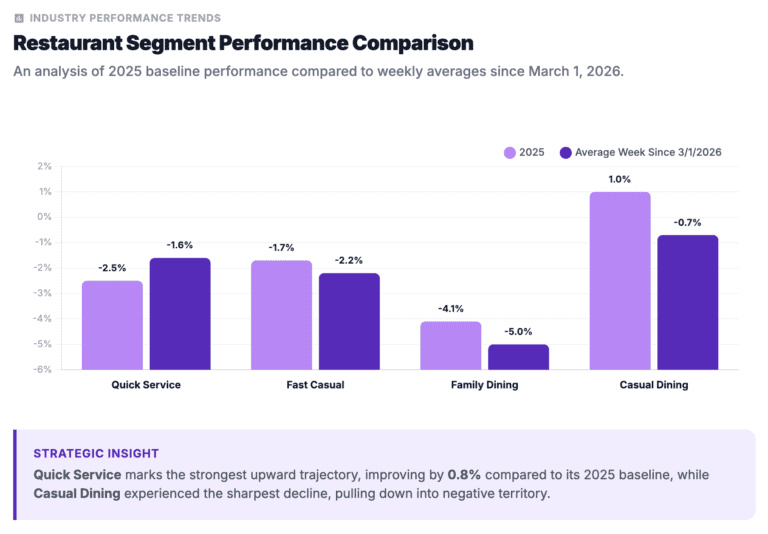
Fast Casual is Winning
The Fast Casual segment appears to be capturing demand in high GLP-1 adoption zip codes. Many Fast Casual brands offer customizable, lighter, bowl-and-wrap formats which perform strongly with GLP-1 consumers.
Hamburger Holding Up Better in Markets with High GLP-1 Exposure
Perhaps counterintuitively, the hamburger cuisine fared better in high GLP-1 zip codes.
Because GLP-1s cause significant appetite reduction and weight loss, doctors advise their patients to consume enough protein to ensure the body loses fat rather than lean muscle. High protein-density burgers are a quick and easy meal to accomplish this.
Healthy Cuisines Seem to Be Losing Share
Most surprisingly, in high GLP-1 exposure markets, healthy cuisine traffic fell compared to other markets.
Possibly healthier eating is more easily managed (portioning, density) in a home environment, and therefore the demand for healthy food is higher overall but has also shifted towards grocery. Similarly, since hunger pangs are reduced, dieters have less of a need for a healthy “on-the-go” option and instead can just wait to get home to eat.
Additionally, many brands which aren’t primarily “healthy” restaurants are adding healthy menu options. Chipotle is adding a “grab-and-go protein cup” and Olive Garden has created a “lighter portions” menu in reaction to growing GLP-1 usage. These offerings may be stealing share from brands which specialize in healthy cuisines.
GLP-1 Usage to Grow
In a short span of time, many barriers to getting GLP-1s have been eliminated. Oral medications are now available. This eliminates the need for needles, which need to be refrigerated.
And while initially Ozempic was seen as a drug for the wealthy, generics are now pushing down the price. Additionally, Medicare now covers these diabetes and weight loss medications.
JP Morgan estimates that by 2030, 30 million Americans will be on GLP-1s. Restaurant executives can no longer afford to ask “are GLP-1s affecting the restaurant industry?” but rather “how are GLP-1s affecting the industry and how can my brand pivot to match these shifting demands?” Black Box Intelligence will continue to track these trends.
State of the Restaurant Industry Webinar Series
Want More Detail? Register for our Quarterly Deep Dives on the Restaurant Industry
Unrivaled Restaurant Financial Intelligence
Explore Daily Comp Sets With BBI


More Insights and Research from Black Box Intelligence