March 2026 Monthly Second Helping: Highlighting Hot Topics in the Industry
What BBI Data Tells Us About Gas Price Impact on the Restaurant Industry
BBI data shows traffic declines sharper when gas prices at their highest.
As the war in Iran enters its fifth straight week and national gas prices have hit $4 a gallon for the first time since 2022, many restaurateurs wonder how this will impact their traffic.
Since last month the national average for a gallon of gas has increased nearly a full dollar and with Trump recently threatening to bomb Iran’s oil wells, the situation could get worse.
This comes at a difficult time for a restaurant industry that has been facing a weakening in consumer spending since the middle of 2025. In Q1 2026 (as of March 22nd), industry traffic is down -1.8%. Perhaps this figure might not seem too negative but given the easy lap (-3.0% in Q1 2025 which is lapping over an even weaker Q1 2024 at -3.6%), it’s been a disappointing quarter.
2026 was already being predicted to be tough for the industry based on the macroeconomic conditions before this latest headwind, so a long energy crisis is the last thing it needs.
$3.50 is the Threshold for Gas Prices
When we take traffic growth by month since 2017 excluding months affected by COVID (March 2020- December 2022) and compare it to United States Retail Gasoline prices, we actually find no correlation at the national industry level.
However, at the extreme, when we see gas prices at their highest levels, industry traffic growth tends to drop.
The past several years have been difficult for the restaurant industry. As a result, many restaurant chains have shuttered sizeable portions of their units. Unfortunately, that trend is likely to continue in 2026.
The average month since 2017 (excluding COVID months) had -2.0% same-store traffic growth. The average month where the price of gas was $3.50 had -2.4% traffic growth. When the average price was over $3.80 (only two months in this dataset), the average was -2.9% same-store traffic growth.
Trade Downs Accelerate
While there is no correlation between gas prices and traffic growth on the industry level, on the segment level, it is a very different story.
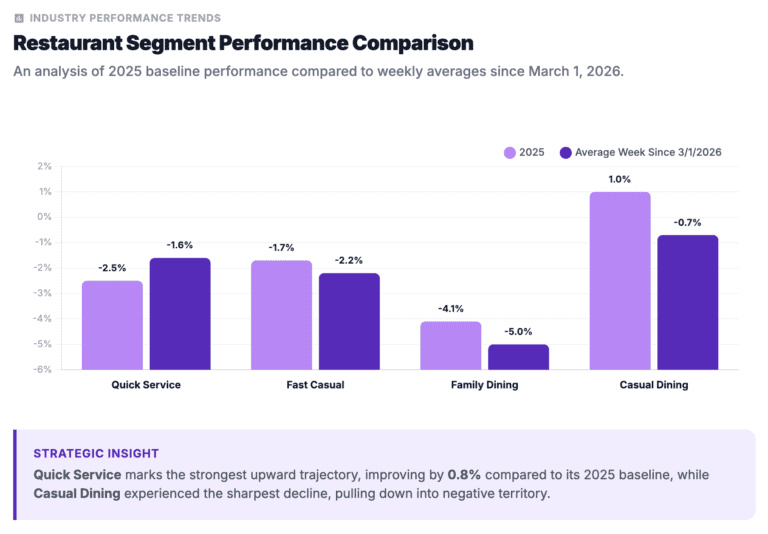
As gas prices rise, we tend to see trade downs. There is a negative correlation between Casual Dining same-store traffic growth and retail gas prices and a very negative correlation with Family Dining.
Limited Service segments saw the benefit. Both Limited Service segments (Quick Service and Fast Casual) tend to see an acceleration in their same-store traffic growth as gas prices get higher, especially Fast Casual which had a very strong correlation.
Upscale Casual and Fine Dining traffic didn’t have much of a relationship with gas prices. They tend to attract higher net worth patrons who are less affected by the gas prices.
Delivery Suffers
Unsurprisingly, delivery sales also have a negative correlation with gas prices on the industry level.
This is true of all segments, except Quick Service. Perhaps those that are trading down from segments with higher price points are saving enough money by switching to QSR that they’re willing to pay a delivery fee and spend a little more.
While everyone waits to see what happens next with gas prices, our data shows they’re a little less likely to be waiting at a Full Service restaurant.
State of the Restaurant Industry Webinar Series
Want More Detail? Register for our Quarterly Deep Dives on the Restaurant Industry
Unrivaled Restaurant Financial Intelligence
Explore Daily Comp Sets With BBI


More Insights and Research from Black Box Intelligence